Translate

Powered By Blogger

Total Pageviews

Showing posts with label First Aid. Show all posts

Saturday, 11 May 2024

First Aid :- Hands-Only CPR (FAQ)

www.safetygoodwe.com
Chapter : First Aid 

First Aid : Hands-Only CPR

Frequently Asked Questionnaire

Q: What is Hands-Only CPR?
A: “Hands-Only CPR” is cardiopulmonary resuscitation (CPR) without mouth-to-mouth breaths. It is recommended for use by people who see an adult suddenly collapse in the “out-of-hospital” setting. It consists of two steps:
  1. Call 108 (or send someone to do that).
  2. Begin providing high-quality chest compressions by pushing hard and fast in the center of the chest with minimal interruptions.
Q: Who should receive Hands-Only CPR?
A: Hands-Only CPR is recommended for use on adults who suddenly collapse.
The AHA recommends conventional CPR (that is, CPR with a combination of breaths and compressions) for adult victims who are found already unconscious and not breathing normally, and for any victims of drowning or collapse due to breathing problems.

Q: Do responders need to take a training course to learn how to do Hands-Only CPR?
A: CPR is a psychomotor skill. The AHA continues to recommend that you take a CPR course to learn and practice the skills of CPR, including how to give high-quality chest compressions.
People who have had CPR training are more confident about their skills than those who have not been trained (or have not been trained in the last 5 years).
Even a very short CPR training program done at home, like the AHA’s 22-minute CPR Anytime program, is helpful.

Q: Do responders still need to learn “conventional” CPR with mouth-to-mouth breathing?
A: The AHA still recommends that people learn conventional CPR. There are many medical emergencies that cause a person to be unresponsive and to stop breathing normally, including adult victims who are found already unconscious and victims of drowning or collapse due to breathing problems. In those emergencies, CPR that includes mouth-to-mouth breathing may provide more benefit than Hands-Only CPR.

Q: Is Hands-Only CPR as effective as conventional CPR?
A: Hands-Only CPR performed by a bystander has been shown to be as effective as conventional CPR in the first few minutes of an out-of-hospital sudden cardiac arrest.
Conventional CPR may be better than Hands-Only CPR for certain victims, but any attempt at CPR is better than no attempt.

Q: Will Hands-Only CPR increase the chance of someone taking action in a cardiac emergency?
A: Yes. In a national survey, Americans who have not been trained in CPR within the last 5 years stated that they would be more likely to perform Hands-Only CPR than conventional CPR. In addition, Hands-Only CPR offers an easy-to-remember and effective option to those bystanders who have been previously trained in CPR but are afraid to help because they are not confident that they can remember and perform the steps of conventional CPR.

Q: What is someone trained in conventional CPR that includes breathing (30 compressions to 2 breaths, or 30:2 CPR) who sees an adult suddenly collapse to do?
A: Call 108 and start CPR. If the person is confident in the ability to provide conventional CPR, provide either the conventional CPR or Hands-Only CPR.
Continue CPR until an automated external defibrillator (AED) arrives and is ready for use or EMS providers take over care of the victim.
If the responder is not confident in the ability to provide conventional CPR, then provide Hands-Only CPR and continue until an AED arrives and is ready for use or EMS providers take over care of the victim.

Q: How long should someone trained in conventional CPR that includes breathing do Hands-Only CPR before switching to conventional CPR?
A: At this point, there is not sufficient data to provide a specific recommendation. Trained rescuers will take over when they arrive at the victim’s side.

Q: For lay rescuers who have a duty to respond to emergencies as part of their job and who have received training in Heartsaver CPR, AED, and/or first aid, what kind of CPR should they perform?
A: These responders may use Hands-Only CPR or conventional CPR if they witness an adult suddenly collapse.
AHA recommends that these responders call 108, continue CPR until an AED arrives and is ready for use, or EMS providers take over care of the victim.

Q: Should a responder using an AED that prompts CPR with breathing just give chest compressions?
A: Follow the directions provided by the AED and minimize any interruptions to chest compressions.
Remember, all victims of cardiac arrest should receive high-quality chest compressions. You should push hard and fast in the center of the chest with minimal interruption.

Q: Not all people who suddenly collapse are in cardiac arrest. Will CPR seriously hurt them?
A: Adults who collapse and are not responsive are likely to have sudden cardiac arrest, and their chance of survival is nearly zero unless someone takes action immediately if sudden cardiac arrest is the cause of the collapse.

If an adult has collapsed for reasons other than sudden cardiac arrest, Hands-Only CPR could still help by causing the person to respond (begin to move, breathe normally, or speak).
If that occurs, Hands-Only CPR can be stopped. Otherwise, chest compressions should continue until EMS providers arrive.

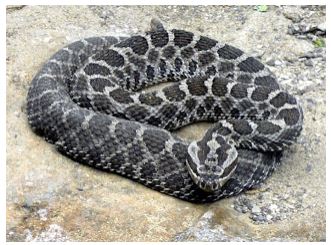
First aid :- Snake Bite

Overview:

Snakes are remarkable animals, successful on land, in the sea, in forests, in grasslands, in lakes, and in deserts. Despite their sinister reputation, snakes are almost always more scared of you than you are of them. Most snakes do not act aggressive toward humans without provocation.
Snakes are meat eaters and they catch prey that includes insects, birds, small mammals, and other reptiles, sometimes including other snakes. Only about 400 of 3,000 snake species worldwide are poisonous. About 25 species of poisonous snakes are found in North America. Many snakes kill their prey by constriction. In constriction, a snake suffocates its prey by tightening its hold around the chest, preventing breathing or causing direct cardiac arrest. Snakes do not kill by crushing prey. Some snakes grab prey with their teeth and then swallow it whole.
Snakes are cold-blooded. Thus, they are unable to increase their body temperature and stay active when it is cold outside. They are most active at 25-32 C (77-90 F).

Definition:

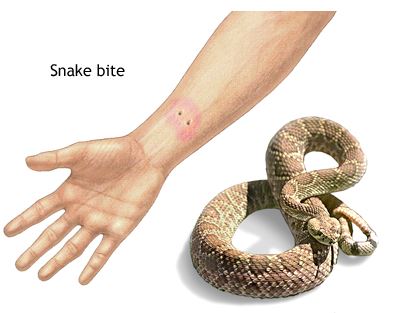
Snake bites occur when a snake bites the skin. They are medical emergencies if the snake is venomous.
Venomous animals account for a large number of deaths and injuries, worldwide. Snakes alone are estimated to inflict 2.5 million venomous bites each year, resulting in about 125,000 deaths. The actual number may be much larger. Southeast Asia, India, Brazil, and areas of Africa have the most deaths due to snakebite.

Alternative Names:

Bites - snakes

Considerations:

Snake bites can be deadly if not treated quickly. Children are at higher risk for death or serious complications due to snake bites because of their smaller body size.
The right anti venom can save a person's life. Getting to an emergency room as quickly as possible is very important. If properly treated, many snake bites will not have serious effects.

Causes:

Venomous snake bites include bites by any of the following:
  • Cobra
  • Copperhead
  • Coral snake
  • Cottonmouth (water moccasin)
  • Rattlesnake
  • Viper
  • Various snakes found at zoos
All snakes will bite when threatened or surprised, but most will usually avoid people if possible, and only bite as a last resort.
Snakes found in and near water are often mistaken as being venomous. Most species of snake are harmless and many bites are not life-threatening, but unless you are absolutely sure that you know the species, treat it seriously.

Symptoms:

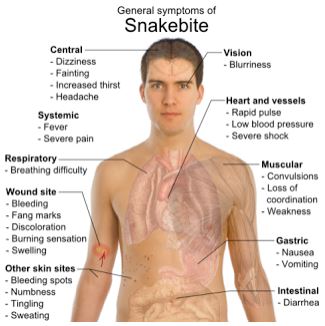
Symptoms depend on the type of snake, but may include:
  • Bleeding from wound
  • Blurred vision
  • Burning of the skin
  • Convulsions
  • Diarrhea
  • Dizziness
  • Excessive sweating
  • Fainting
  • Fang marks in the skin
  • Fever
  • Increased thirst
  • Loss of muscle coordination
  • Nausea and vomiting
  • Numbness and tingling
  • Rapid pulse
  • Tissue death
  • Severe pain
  • Skin discoloration
  • Swelling at the site of the bite
  • Weakness.
Rattlesnake bites are painful when they occur. Symptoms usually begin right away and may include:
  • Bleeding
  • Breathing difficulty
  • Blurred vision
  • Eyelid drooping
  • Low blood pressure
  • Nausea and vomiting
  • Numbness
  • Pain at site of bite
  • Paralysis
  • Rapid pulse
  • Skin color changes
  • Swelling
  • Tingling
  • Tissue damage
  • Thirst
  • Tiredness
  • Weakness
  • Weak pulse.
Cottonmouth and copperhead bites are painful right when they occur. Symptoms, which usually begin right away, may include:
  • Bleeding
  • Breathing difficulty
  • Low blood pressure
  • Nausea and vomiting
  • Numbness and tingling
  • Pain at site of bite
  • Shock
  • Skin color changes
  • Swelling
  • Thirst
  • Tiredness
  • Tissue damage
  • Weakness
  • Weak pulse

Physically based symptoms:

  • Most snake bites, whether by a venomous snake or not, will have some type of local effect. There can be minor pain and redness in over 90% of cases, although this varies depending on the site.
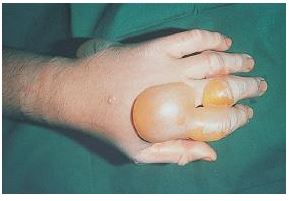
  • Bites by vipers and some cobras may be extremely painful, with the local area sometimes becoming tender and severely swollen within 5 minutes. The bite area may also bleed and blister.
  • Pit viper bites may include lethargy, weakness, nausea, and vomiting. Then over time may develop more life-threatening symptoms such as low blood pressure, rapid breathing, severe tachycardia (heart beats very fast), altered perception of what is happening around them and respiratory failure (breathing difficulty or breathing stops). It this happens CPR should be applied.
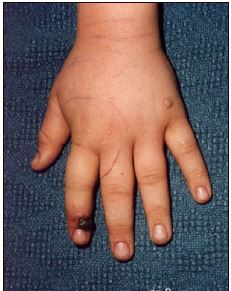
Some example of different snakes bites
Cobra snake bite
Copperhead snake bite
Rattlesnake bite
Timber rattlesnake bite

First Aid:

1. Keep the person calm. Reassure them that bites can be effectively treated in an emergency room. Restrict movement, and keep the affected area below heart level to reduce the flow of venom.
2. If you have a pump suction device (such as that made by Sawyer), follow the manufacturer's directions.
3. Remove any rings or constricting items, because the affected area may swell. Create a loose splint to help restrict movement of the area.
4. If the area of the bite begins to swell and change color, the snake was probably venomous.

5. Monitor the person's
  • vital signs
  • pulse
  • shock
  • paleness
temperature, , rate of breathing, and blood pressure -- if possible. If there are signs of (such as ), lay the person flat, raise the feet about a foot, and cover the person with a blanket.
6. Get medical help right away.
7. Bring in the dead snake only if this can be done safely. Do not waste time hunting for the snake, and do not risk another bite if it is not easy to kill the snake. Be careful of the head when transporting it -- a snake can actually bite for several hours after it's dead (from a reflex).

Snake Identifiers:

Now lets get down to the points that serve as snake identifiers:
  • Length: When it comes to the length of the snake, the first thing that you have to do is imagine how it would look when it is stretched out. The small snakes would be up to 12 inches (30 cm) long and they would include snakes like red belly snake, brown snake. Then there are the medium sized snakes queen snakes, milk snakes, etc. And then you have the large snakes like the cobras, rattlesnakes, water snakes, etc. 
  • Shape: This acts as an important snake identifier. The question that you have to ask yourself is whether the body of the snake is slender, heavy or thick. The thick snake would include the cottonmouth, boa, etc. while the slender one will include the ribbon snake, vine snake, etc. 
  • Head: This might be a confusing snake identifier because many snakes are actually known to flatten their heads when they are threatened. This can be a bit confusing owing to the fact that pit vipers are known to have arrowheads. 
  • Eyes: This is rather a simply snake identification technique that can help you tell apart a poisonous from a non-poisonous one. Non-venomous snakes are known to have a round pupil whereas the venomous snakes are known to have a vertical pupil similar to the cat's eye.
Although it is a true fact that snakes can be dangerous, you have to remember that they usually keep to themselves. So, if you've found a snake in your yard or inside your home, worry not. The snake can be easily identified – all you have to do is take note of the identifiers I have listed above. This information can then be conveyed to a professional, who in turn will determine whether or not the snake is poisonous.

When to Seek Medical Care:

Any snakebite victim should go to a hospital emergency department. Identification of the snake as venomous or nonvenomous should not be used as criteria whether to seek medical care. If someone can identify the type of snake, a call to the emergency department will help the staff prepare for quick treatment with antivenin, if needed. Bites by nonvenomous species require proper wound care. Victims should receive a tetanus booster if they have not had one within the last 5 years.

Snake bite Self-Care at Home:

Common sense, hopefully, will guide a person's efforts if they are bitten by a snake or are witness to someone else being bitten. Even a bite from a nonvenomous snake requires excellent wound care. The patient needs a tetanus booster if he or she has not had one within 5 years. Wash the wound with large amounts of soap and water. Inspect the wound for broken teeth or dirt.
Take the following measures:
  • Prevent a second bite or a second victim. Do not try to catch the snake as this can lead to additional victims or bites. Snakes can continue to bite and inject venom with successive bites until they run out of venom.
  • Identify or be able to describe the snake, but only if it can be done without significant risk for a second bite or a second victim.
  • Safely and rapidly transport the victim to an emergency medical facility.
  • Individuals should provide emergency medical care within the limits of their training.
The two guiding principles for care often conflict during evacuation from remote areas:
  • First, the victim should get to an emergency care facility as quickly as possible because antivenin (medicine to counteract the poisonous effects of the snake's venom) could be life-saving.
  • Second, the affected limb should be used as little as possible to delay absorption and circulation of the venom.

Snakebite Prevention:

The snake is almost always more scared of the human, than the human is of the snake, it is assumed because giving the snake the opportunity to escape prevents most bites. However, most snakes will try to bite if cornered or frightened.
  • Avoid areas where snakes may be hiding, such as under rocks and logs.
  • Even though most snakes are not venomous, avoid picking up or playing with any snake unless you have been properly trained.
  • If you hike often, consider buying a snake bite kit (available from hiking supply stores). Do not use older snake bite kits, such as those containing razor blades and suction bulbs.
  • Don't provoke a snake. That is when many serious snake bites occur.
  • Tap ahead of you with a walking stick before entering an area where you can't see your feet. Snakes will try to avoid you if given enough warning.
  • When hiking in an area known to have snakes, wear long pants and boots if possible.
  • Snakebites are often associated with alcohol use. Alcohol intake can weaken a person's inhibitions, making it more likely that they might attempt to pick up a snake. Alcohol also decreases coordination, increasing the probability of a mishap.
  • Individuals can help prevent significant bites by wearing boots while hiking or working where snakes may live. Long pants can reduce the severity of a bite. When in snake country, be cautious where you place your hands and feet (for example, when gathering firewood or collecting berries), and never walk barefooted.

Snakebite Dos and Don 'ts:

  • DO remain calm and try to slow down your breathing by breathing in and out of your nose.
  • DO keep the wound below your heart level.
  • DO monitor your or the victims vital signs.
  • DO keep the portion of the body that was bitten immobilized and move it as little as possible.
  • DO wash the wound with soap and water if available.
  • DO lay the victim flat with their feet raised about 1 foot above their body if they go into shock.
  • DO remove any rings, necklaces, watches, ankle wraps, knee braces, or anything else that could be restrictive to proper blood flow.
  • DO loosely apply a bandage roughly 2 to 4 inches above the bite on the side closest to your heart if you are unable to seek specialized care within approximately 30 minutes. However, the bandage should be loose enough to be able to place 1 to 2 fingers underneath it. The idea here is to slow down the venom without significantly disrupting blood flow or cutting off blood flow all together. Be sure to check the bandage frequently to ensure it remains semi-loose as the limb may continue to swell and require the bandage be readjusted.

Don 'ts:

  • NO aspirin or other pain relievers.
  • NO tourniquets. This cuts blood flow completely and may result in loss of the affected limb.
  • DO NOT try to suck the venom out of the wound or cut into the bite with a knife. Such measures have not been proven useful and may cause further injury (see below explanation).
  • DO NOT apply a cold compress or ice on the bite. Research has shown this to be potentially harmful. 
  • DO NOT raise the wound above the heart. Raising it can cause venom to travel into the body. Holding it down, can increase swelling. 
  • DO NOT use electric shock or a stun gun on the bite area. This method is under study and has yet to be proven effective. It could harm the victim.
  • DO NOT wash the snake bite area treatment strongly recommend against cleaning the wound. Traces of venom left on the skin/bandages from the strike can be used in combination with a snake bite identification kit to identify the species of snake. This speeds determination of which anti-venom to administer in the emergency room.
  • DO NOT try and capture the snake. If it's safe you can try to take a photo with a camera or with your phone. This is the best way in aiding snake identification.
  • Reassure the victims: Calm the victim down. Unnecessary panic will raise the pulse rate and blood pressure and moves the venom into the system faster. Tell the victim that 70% of snakebites are from non poisonous species. of the remaining 30% only half will actually involve injecting venom. The chances are they are OK !

  • Immobilise the bitten limb without compression: If the bite is on hand or arm place it in a sling bandage or use a piece of cloth to support the arm. In the case of leg bite, use a splint to support both legs and bandage them together . Do not tie the bandages tightly. we are only trying to immobilise not apply any pressure.

  • Get the patient to hospital as fast as safely possible: Don't waste time washing the wound, seeking traditional remedies or applying any drugs or chemicals to the victim. Science has shown that traditional remedies do not work and simply waste valuable time. Snakestones do not absorb venom and many herbal remedies make the situation worse. Keep the patient as immobile as possible


First Aid :-Things You Should Never Do for Burns

www.safetygoodwe.com
Chapter : First Aid 

First Aid:  Things You Should Never Do for Burns

If you’ve ever felt the sting of a hot curling iron or a sizzling barbecue grill, you know how much these relatively minor burns hurt. You probably ran cold water on the singed area or applied some ice

  • It is not a good idea
  • and went about your merry way.

But would you know what to do for a more serious burn?

First, it’s helpful to have an awareness of the degree of injury and whether it’s a minor burn (one that can be treated at home) or a major burn (one that needs medical attention). Once you’ve nailed that, treatment is pretty straightforward.

Minor Burns

If the skin is unbroken:
  • Apply cool (not cold or ice) water for at least 5 minutes by running water over the burn, soaking it in a water bath or applying a clean, wet towel.
  • Use a moisturizing lotion, such as aloe vera, once the skin has cooled.
  • Protect the burn from pressure and friction and cover with a clean, dry cotton dressing.
  • Relieve pain and swelling with ibuprofen or acetaminophen.
  • Update your tetanus immunization, as even minor burns can lead to this dangerous bacterial infection.
Minor burns will usually mend without further treatment, but if it hasn’t healed in two weeks or is accompanied by other symptoms, call your doctor.

Major Burns

Major burns require immediate medical care  call 108 if you can’t transport the burn victim safely.
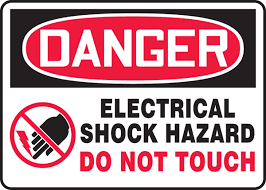
  • Remove the cause of the burn (stop, drop and roll) but don’t touch anyone who may have received an electrical burn. Use a nonmetallic object to move the person away from exposed wires.
  • Check for breathing and administer CPR if needed.
  • Check for signs of shock.
  • Protect the burn area from pressure and friction and wrap in a thick, clean, dry cotton cloth; use a clean sheet if the burn area is large.
  • Raise the body part that is burned above the level of the heart.

First aid : Burns Injuries

www.safetygoodwe.com
Chapter : First Aid 

First aid : Burns Injuries 

Definition:

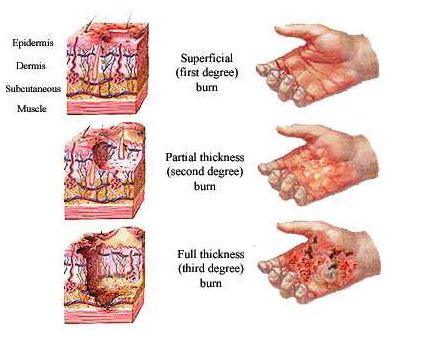
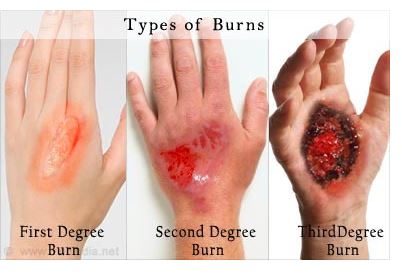
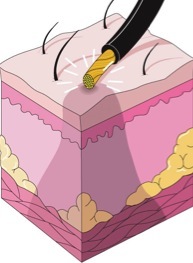
A burn is damage to the skin or underlying tissue caused by heat. There are 3 levels of severity; 1st (Superficial), 2nd (Partial thickness), 3rd (Full thickness).
There are three levels of burns:
  • First-degree burns affect only the outer layer of the skin. They cause pain, redness, and swelling.
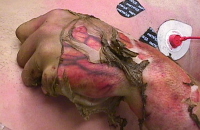
  • Second-degree burns affect both the outer and underlying layer of skin. They cause pain, redness, swelling, and blistering. They are also called partial thickness burns.
  • Third-degree burns affect the deep layers of skin. They are also called full thickness burns. They cause white or blackened, burned skin. The skin may be numb.

Burns fall into two groups:

Minor burns are:
  • First degree burns anywhere on the body.
  • Second degree burns less than 2-3 inches wide.
Major burns include:
  • Third-degree burns.
  • Second-degree burns more than 2-3 inches wide.
  • Second-degree burns on the hands, feet, face, groin, buttocks, or a major joint.
You can have more than one type of burn at a time.

Causes:

Causes of burns from most to least common are:
  • Fire/flame.
  • Scalding from steam or hot liquids.
  • Touching hot objects.
  • Electrical burns.
  • Chemical burns.
Burns can be the result of:
  • House and industrial fires.
  • Car accidents.
  • Playing with matches.
  • Faulty space heaters, furnaces, or industrial equipment.
  • Unsafe use of firecrackers.
  • Kitchen accidents, such as a child grabbing a hot iron or touching the stove.
This list is not all-inclusive.
You can also burn your airways if you breathe in smoke, steam, super heated air, or chemical fumes in poorly ventilated areas.

Symptoms:

Burn symptoms can include:
  • Blisters (intact or ruptured and leaking fluid).
  • Pain (How much pain you have is unrelated to the level of burn. The most serious burns can be painless.)
  • Peeling skin.
  • Shock (watch for pale and clammy skin, weakness, blue lips and fingernails, and a drop in alertness).
  • Swelling.
  • Red, white, or charred skin.
If you have burned your airways, you may have:
  • Burns on the head, face, neck, eyebrows, or nose hairs.
  • Burned lips and mouth.
  • Coughing.
  • Difficulty breathing.
  • Dark, black-stained mucus.
  • Voice changes.
  • Wheezing.

Is it a minor burn or a major burn?

If it's not clear what level of care is needed, try to judge the extent of tissue damage, based on the following burn categories:

1st-degree burn

A first-degree burn is the least serious type, involving only the outer layer of skin. It may cause:
  • Redness
  • Swelling
  • Pain
You can usually treat a first-degree burn as a minor burn. If it involves much of the hands, feet, face, groin, buttocks or a major joint, seek emergency medical attention.

2nd-degree burn

A second-degree burn is more serious. It may cause:
  • Red, white or splotchy skin
  • Swelling
  • Pain
  • Blisters
If the second-degree burn is no larger than 3 inches (7.6 centimeters) in diameter, treat it as a minor burn. If the burned area is larger or covers the hands, feet, face, groin, buttocks or a major joint, treat it as a major burn and get medical help immediately.

3rd-degree burns

The most serious burns involve all layers of the skin and underlying fat. Muscle and even bone may be affected. Burned areas may be charred black or white. The person may experience:
  • Difficulty breathing
  • Carbon monoxide poisoning
  • Other toxic effects, if smoke inhalation also occurred

Helping:

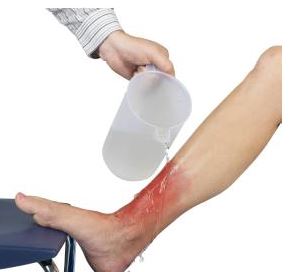
  • For 1st and 2nd degree burns you should cool the area immediately with gently running cold water for about 10-15 minutes, or until it has cooled off. Do not break any blisters as this will make the wound worse.
  • For 3rd degree burns do not put anything on the burn, seek medical help immediately and treat for shock. 3rd degree is extremely life threatening even when a small body part is affected. If there is clothing on the burn do not remove it as this may also remove skin. There is a very high risk of infection from this kind of burn.

Notes:

  • As with all other emergencies make sure the area is safe for you first. Watch out for live wires, hot objects, chemical spills, etc.
  • The severity of a burn can also be increased pending on;
  1. Which part of the body is affected, e.g. face, neck.
  2. The amount of the body that is burnt, e.g. only finger tip or entire arm.
  • With electrical burns check for an exit wound as well as treating for the entrance wound.
  • With chemical burns flush the area with lots of water to get it off the casualty’s skin.
  • Never apply ointments, butter, or other home remedies on burns, as this may make the burn worse, keep the heat trapped in, or cause an infection.

First Aid:

Before giving first aid, it is important to determine what type of burn the person has. If you aren't sure, treat it as a major burn. Serious burns need immediate medical care.Call your local emergency number

For minor burns:

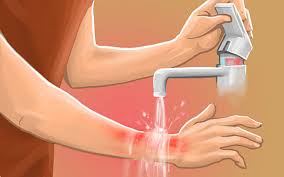
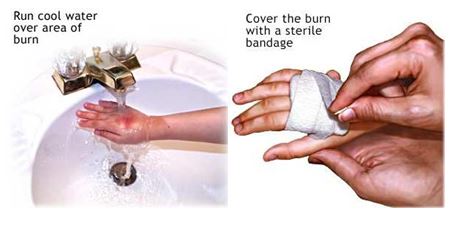
  • Cool the burn to help soothe the pain. Hold the burned area under cool (not cold) running water for 10 to 15 minutes or until the pain eases. Or apply a clean towel dampened with cool tap water.
  • Remove rings or other tight items from the burned area. Try to do this quickly and gently, before the area swells.
  • Don't break small blisters (no bigger than your little fingernail). If blisters break, gently clean the area with mild soap and water, apply an antibiotic ointment, and cover it with a nonstick gauze bandage.
  • Apply moisturizer, aloe vera lotion or gel, or low-dose hydro cortisone cream, which may provide relief in some cases.
  • If needed, take an over-the-counter pain reliever, such as ibuprofen (Advil, Motrin IB, others), naproxen sodium (Aleve) or acetaminophen (Tylenol, others).
  • Consider a tetanus shot. Make sure that your tetanus booster is up to date. Doctors recommend people get a tetanus shot at least every 10 years.

Major burns

Call emergency medical help for major burns. Until an emergency unit arrives, take these actions:
  • Protect the burned person from further harm. If you can do so safely, make sure the person you're helping is not in contact with smoldering materials or exposed to smoke or heat. But don't remove burned clothing stuck to the skin.
  • Check for signs of circulation. Look for breathing, coughing or movement. Begin CPR if needed.
  • Remove jewelry, belts and other restrictive items, especially from around burned areas and the neck. Burned areas swell rapidly.
  • Don't immerse large severe burns in cold water. Doing so could cause a serious loss of body heat (hypothermia) or a drop in blood pressure and decreased blood flow (shock).
  • Elevate the burned area. Raise the wound above heart level, if possible.
  • Cover the area of the burn. Use a cool, moist, bandage or a clean cloth.

Considerations:

Severe burns need immediate medical care. This can help prevent scarring, disability, and deformity.
Burns on the face, hands, feet, and genitals can be particularly serious.
Children under age 4 and adults over age 60 have a higher chance of complications and death from severe burns because their skin tends to be thinner than in other age groups.

When to Contact a Medical Professional:

Call your local emergency number if:
  • The burn is very large - about the size of your palm or larger.
  • The burn is severe (third degree).
  • You aren't sure how serious it is.
  • The burn is caused by chemicals or electricity.
  • The person shows signs of shock.
  • The person breathed in smoke.
  • Physical abuse is the known or suspected cause of the burn.
  • There are other symptoms associated with the burn.
For minor burns, call your doctor if you still have pain after 48 hours.
Call immediately if signs of infection develop. These signs include:
  • Drainage or pus from the burned skin.
  • Fever.
  • Increased pain.
  • Red streaks spreading from the burn.
  • Swollen lymph nodes.
Also call immediately if symptoms of dehydration occur with a burn:
  • Decreased urination
  • Dizziness
  • Dry skin
  • Headache
  • Light- headedness
  • Nausea (with or without vomiting)
  • Thirst

Prevention:

To help prevent burns:
  • Install smoke alarms in your home. Check and change batteries regularly.
  • Teach children about fire safety and the hazards of matches and fireworks.
  • Keep children from climbing on top of a stove or grabbing hot items like irons and oven doors.
  • Turn pot handles toward the back of the stove so that children cannot grab them and they cannot accidentally be knocked over.
  • Place fire extinguishers in key locations at home, work, and school.
  • Remove electrical cords from floors and keep them out of reach.
  • Know about and practice fire escape routes at home, work, and school.
  • Set the water heater temperature at 120 degrees or less.

Dos:

  • Stop the burning. Remove the victim from the heat source.
  • Check for any airway obstruction, and to check breathing and circulation. Administer CPR if necessary.
  • For thermal, chemical or contact burns, the first step is to run cold water over the burn for a minimum of 30 minutes. If the burn is small enough, keep it completely under water. Flushing the burn takes priority over calling for help. Flush the burn FIRST.
  • Remove clothing that is not stuck to the burn by cutting or tearing it.
  • Remove rings, belts, shoes and tight clothing before swelling occurs.
  • Cover the burn with a clean, cotton material. If you do not have clean, cotton material, do not cover the burn with anything.
  • Keep the victim covered with a blanket to maintain a normal body temperature until medical help arrives.
  • Call immediately for emergency medical assistance if the burn is extensive/ severe/ chemical/ electrical burn/ uncertainty about the burn's severity/ the victim shows signs of shock/ the victim has an airway burn.    

Do Not:

  • Do NOT apply ointment, butter, ice, medications, cream, oil spray, or any household remedy to a severe burn.
  • Do NOT breathe, blow, or cough on the burn.
  • Do NOT disturb blistered or dead skin.
  • Do NOT remove clothing that is stuck to the skin.
  • Do NOT give the person anything by mouth, if there is a severe burn.
  • Do NOT place a severe burn in cold water. This can cause shock.
  • Do NOT place a pillow under the person's head if there is an airways burn. This can close the airways.

FIRST AID FOR BURNS

Safety Videos


Sometimes, inspite of taking precautions, fires do occur and people get burnt. Here’s what you should do in an emergency to minimize the effect of burn:


  • In the event of a burn injury, the affected portion of the body should be placed under cool, slowly running water, or be immersed in cool water for about 10 minutes or till pain subsides.
  • Remove jewellery before the burnt area begins to swell and do not break blisters.
  • Cover burnt area with a clean, sterile dressing.
  • Remove clothing from affected area if burn is superficial. (Superficial burns involve only outer layers of skin).
  • Do not remove clothing if it is a deep tissue burn. (Deep tissue burns involve the entire thickness of the skin).
  • Lay the victim down.
  • Badly burnt limb should be immobilized (hold in such a way that it cannot be moved).
  • Give small amounts of cool water If victim is conscious. (If unconscious, DO NOT give any liquid).
  • Reassure the victim and keep him calm.
  • Immediately take the victim to the hospital, which has a burn-ward.
  • Never apply ghee, butter, oil or any greasy substance on the burnt area.

           REMEMBER TO POUR WATER OVER BURNS
 

First Aid - Electric Shock

www.safetygoodwe.com
Chapter : First Aid 

First Aid - Electric Shock

What is shock:

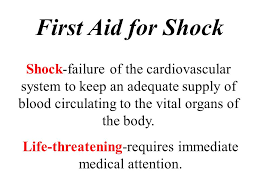
Shock is what happens when the heart and blood vessels are unable to pump enough oxygen-rich blood to the vital organs of the body. Although every illness and involves shock to some degree, it can be a life threatening problem. The best way to protect people from the serious damages that shock can have on the system is to recognize the signs before the person gets into serious trouble. In most cases, only a few of the symptoms will be present, and many do not appear for some time.

Classification of shock:

Hypovolemic Shock: This form of shock is brought on by a decrease in the amount of blood vessels or other fluids in the body. Excessive bleeding from internal and external injuries, fluid loss due to diarrhea, burns, dehydration, and severe vomiting usually cause this kind of shock.
Neurogenic Shock: In the case of neurogenic shock, the blood vessels become abnormally enlarged and the pooling of the blood disallows an adequate blood flow to be maintained. Fainting is an example of this sort of shock, as the blood temporarily pools as the person stands. When the person falls the blood rushes back to the head and the problem is solved.
Psychogenic Shock: This shock is more common, and is known as a “shock like condition”. It is produced by excessive fear, joy, anger, or grief. “Shell shock” is a psychological adjustment reaction to stressful wartime experiences. Treatment for shell shock is limited to emotional support and help from a medical facility.
Anaphylactic Shock: This form of shock is brought on by an allergic reaction from a food, bee sting or other insect bite, and inhalants. For more information on the care and treatment click the link below. Anaphylactic Shock

The most common symptoms are:

  • Pale, cold, clammy and moist skin
  • Vacant or dull eyes, dilated pupils
  • Anxiety, restlessness, and fainting
  • Weak, rapid, or absent pulse
  • Shallow, rapid, and irregular breathing
  • Nausea and vomiting
  • Excessive thirst
  • Person may seem confused or tired
  • Loss of blood pressure

Causes of shock: 

There are several main causes of shock:
  • Heart conditions (heart attack, heart failure)
  • Heavy internal or external bleeding, such as from a serious injury or rupture of a blood vessel
  • Dehydration, especially when severe or related to heat illness.
  • Infection (septic shock)
  • Severe allergic reaction (anaphylactic shock)
  • Spinal injuries (neurogenic shock)
  • Burns
  • Persistent vomiting or diarrhea

Treatment of shock:

1. Call your local emergency help provider for help
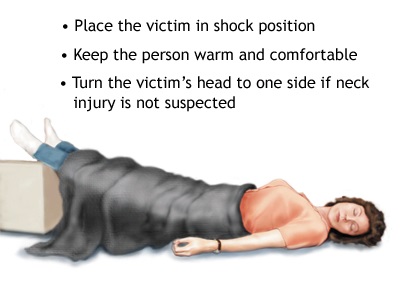
2. Lay the victim face up, on a blanket or coat if possible, and raise the feet above the head unless they are fractured. If the person is bleeding from the mouth or vomiting, tilt their head to the side to avoid fluids going into the lungs and airways. If you are unsure of injuries keep the person laying flat.
3. Loosen tight clothing, braces, belts, jewelry etc to avoid constriction of the waist, neck and chest.
4. Keep the victim comfortable and warm enough to be able to maintain their own body heat. If possible, remove wet clothing and place blankets beneath the victim. NEVER use artificial sources of heat. If they are bleeding severely do not apply heat to the wounded area as it will prevent the blood from clotting as easily
5. Check for other injuries, such as bleeding and burns and treat the other injuries according to first aid procedures. If possible try to splint sprains or broken bones. If you are unsure of how to do this, leave them as they are to avoid further damage.
6. If they claim they are thirsty moisten their lips with water but DO NOT give them anything to drink, as it may induce vomiting.
7. Try to keep the victim calm, excitement and excessive handling will worsen their condition try to assure them help is on the way.
Remember, if you can perform these actions before shock has completely developed you may prevent its occurrence and if it had developed you may stop it from becoming fatal. If shock is left unattended to the victim will die, it is extremely important that first aid be performed as soon as possible.

Self-Care at Home:

  • Call emergency for immediate medical attention any time a person has symptoms of shock. Do not wait for symptoms to worsen before calling for help. Stay with the person until help arrives, and if possible, stay on the line with the emergency dispatcher because they may have specific instructions for you.
  • While waiting for help or on the way to the emergency room, check the person's airway, breathing and circulation (the ABCs). Administer CPR if you are trained. If the person is breathing on his or her own, continue to check breathing every 2 minutes until help arrives.
  • Do NOT move a person who has a known or suspected spinal injury (unless they are in imminent danger of further injury).
  • Have the person lie down on his or her back with the feet elevated above the head (if raising the legs causes pain or injury, keep the person flat) to increase blood flow to vital organs. Do not raise the head.
  • Keep the person warm and comfortable. Loosen tight clothing and cover them with a blanket.
  • Do not give fluids by mouth, even if the person complains of thirst. There is a choking risk in the event of sudden loss of consciousness.
  • Give appropriate first aid for any injuries.
  • Direct pressure should be applied to any wounds that are bleeding significantly.

What is the outlook for shock?

Prompt treatment of medical shock is essential for the best outcome. Moreover, the outlook depends on the cause of the shock, the general health of the patient, and the promptness of treatment and recovery.
  • Generally, hypovolemic shock and anaphylactic shock respond well to medical treatment if initiated early.
  • Septic shock is a serious condition with a mortality rate of 24% to 50% according to some estimates. The sooner the infection is treated and fluids are administered, the greater the chances of success. Hospitals are now developing and utilizing specific protocols to identify and aggressively treat septic shock patients.
  • Cardiogenic shock has a poor prognosis, with only 1/3 of patients surviving. Because this type of shock results from injury or dysfunction of the heart it is often difficult to treat and overcome.
  • Spinal shock also has a very poor prognosis because the spinal cord mediates so many important bodily functions. There are currently very few effective treatments but medical research is making advances in the treatment of spinal injuries.

How Does Electric Shock and Lightning Work:

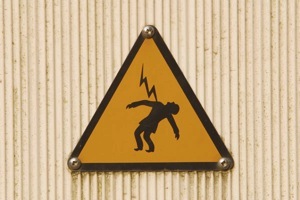
  • An electric shock occurs when a person comes into contact with an electrical energy source.
  • Electrical energy flows through a portion of the body causing a shock.
  • Exposure to electrical energy may result in no injury at all or may result in devastating damage or death.
  • Many people get electric shocks obtained from man-made objects such as electrical appliances, electrical wires, and electrical circuitry.
  • In addition, lightning strikes are a natural form of electric shock.
  • Burns are the most common injury from electric shock and lightning strikes.

Electric Shock Causes:

Electrical injury can be caused by:
  • Accidental contact with exposed parts of electrical appliances or wiring
  • Flashing of electric arcs from high-voltage power lines
  • Lightning
  • Machinery or occupational-related exposures
  • Young children biting or chewing on electrical cords, or poking metal objects into an electrical outlet

Symptoms:

Symptoms depend on many things, including:
  • Type and strength of voltage
  • How long you were in contact with the electricity
  • How the electricity moved through your body
  • Your overall health

Symptoms may include:

  • Changes in alertness (consciousness)
  • Broken bones
  • Heart attack (chest, arm, neck, jaw, or back pain)
  • Headache
  • Problems with swallowing, vision, or hearing
  • Irregular heartbeat
  • Muscle spasms and pain
  • Numbness or tingling
  • Breathing problems or lung failure
  • Seizures
  • Skin burns

First Aid:

1. If you can do so safely, turn off the electrical current. Unplug the cord, remove the fuse from the fuse box, or turn off the circuit breakers. Simply turning off an appliance may NOT stop the flow of electricity. Do NOT attempt to rescue a person near active high-voltage lines.

2. Call your local emergency number, such as emergency.
3. If the current can't be turned off, use a non-conducting object, such as a broom, chair, rug, or rubber doormat to push the person away from the source of the current. Do not use a wet or metal object. If possible, stand on something dry that doesn't conduct electricity, such as a rubber mat or folded newspapers.
4. Once the person is away from the source of electricity, check the person's airway, breathing, and pulse. If either has stopped or seems dangerously slow or shallow, start first aid.
5. If the person has a burn, remove any clothing that comes off easily and rinse the burned area in cool, running water until the pain subsides. Give first aid for burns.
6. If the person is faint, pale, or shows other signs of shock, lay him or her down, with the head slightly lower than the trunk of the body and the legs elevated, and cover him or her with a warm blanket or a coat.
7. Stay with the person until medical help arrives.
8. Electrical injury is frequently associated with explosions or falls that can cause additional severe injuries. You may not be able to notice all of them. Do not move the person's head or neck if the spine may be injured.
9. If you are a passenger in a vehicle struck by a power line, remain in it until help arrives unless a fire has started. If necessary, try to jump out of the vehicle so that you do not maintain contact with it while also touching the ground.

DO NOT:

Stay at least 20 feet away from a person who is being electrocuted by high-voltage electrical current (such as power lines) until the power is turned off.
  • Do NOT touch the person with your bare hands if the body is still touching the source of electricity.
  • Do NOT apply ice, butter, ointments, medicines, fluffy cotton dressings, or adhesive bandages to a burn.
  • Do NOT remove dead skin or break blisters if the person has been burned.
  • After the power is shut off, do NOT move the person unless there is a risk of fire or explosion.

Prevention:

  • Avoid electrical hazards at home and at work. Always follow the manufacturer's safety instructions when using electrical appliances.
  • Avoid using electrical appliances while showering or wet.
  • Keep children away from electrical devices, especially those that are plugged in to an electrical outlet.
  • Keep electrical cords out of children's reach.
  • Never touch electrical appliances while touching faucets or cold water pipes.
  • Teach children about the dangers of electricity.
  • Use child safety plugs in all electrical outlets.

First aid : Bones and Joint Injuries

www.safetygoodwe.com
Chapter : First Aid 

First aid : Bones and Joint Injuries

Introduction:

A fracture is a break or crack in a bone that can be caused by an accident, fall, or blow. Symptoms include a snapping sound as bone breaks, bone protruding from skin, detectable deformity of bone, abnormal movement of bone, grating sensation during movement, pain and tenderness, difficulty in moving or using the affected part, swelling, and discoloration.
A sprain refers to stretched or torn tendons, ligaments, and blood vessels around a joint and can be caused by an accident, fall, or blow. Symptoms of a sprain include pain, tender­ness, swelling, and discoloration in the joint area.
A muscle strain refers to stretched or torn muscle. It can be caused by excessive physical effort or improper posture during activity. Symptoms include pain, stiffness, and possibly swelling in the affected area.
It is sometimes difficult to tell the difference between a fracture and a sprain or strain until an X-ray has been performed. If you cannot tell, treat it as a fracture.

Definition:

  • This is an injury to a bone, a joint, a ligament, or a tendon.
  • Joint injuries usually involve a dislocation. This is where the bone has popped out of its socket. This may be accompanied with a fracture, a strain, or a sprain. It may pop back in it may not. Either way seek medical help. Do not push it back into place.
  • Tendons are strong tissues that connect a muscle onto a bone. When a tendon tears it is called a strain. When they become torn they take a very long time to heal, many times never as good as before, and sometimes surgery is required to reattach them.
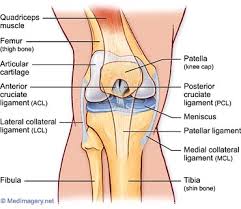
  • When a ligament is torn it is called a sprain. Ligaments connect a bone to another bone. These are found around the joints. Ligaments are very strong, but, as with tendons, when they tear they take a long time to heal, never as good as before, and sometimes surgery is required.

Classification:

A Green stick Fracture is when the bone only cracks, and does not fully break. Because these do not break the skin, they should be treated as a Single Fracture. These fractures can be determined by using x-rays.
A Bending Fracture occurs in children only. In this case the bone bends but does not actually break.
A Single Fracture is when the bone breaks in one place, and does not pierce the skin.
A Compound Fracture is when the bone has broken into two pieces
A Commuted Fracture is when the bone is broken in more than two places or crushed.
An Open or Compound Fracture is when the bone has actually punctured the skin and is visible. These breaks are very severe and have a high risk on infection. DO NOT try to set these breaks yourself, instead get professional medical help immediately.

Causes:

  • Any kind of force that is greater than what the tissue can withhold will cause such an injury. Some common activities include falling, twisting, getting hit, etc.

Fracture:

1. SEEK MEDICAL ATTENTION IMMEDIATELY. Call for EMS, or transport victim to emergency room after immobilizing affected area. Wait for EMS and DO NOT attempt to transport victim if you suspect head, back, or neck injury; if there's a visible deformity of bone; or if the victim cannot be splinted or transported without causing more pain.

2. Suspect back or neck injury if victim is unconscious or has head injury, neck pain, or tingling in arms or legs. If neck or back injury suspected, DO NOT move victim unless necessary to save victim's life.

3. Immobilize and support affected bone in position found. DO NOT try to push protruding bone back into body or let victim move or use affected area.

4. Control any bleeding through direct pressure, but DO NOT elevate affected area.

5. If bone is protruding, cover with clean cloth once bleeding is controlled.

6. Observe for shock . DO NOT give victim anything to eat or drink.

7. Immobilize injured area, and, if no open wound present, apply ice pack wrapped in clean cloth.

Apply ice pack to affected
area and cover with cloth.
Immobilizing Fractured Bone:
  1. Check for sensation, warmth, and color of toes or fingers below suspected break.
  2. Place padded splint under area of suspected break:

Use belts or neckties to bind splint to arm but do not bind
on top of the break.
-Use board, rolled newspaper or maga­zines, broomstick, or rolled blanket for splint.

-Wrap splint in cloth or towels for padding.

-Bind splint to limb using neckties, cloth, belts, or rope. DO NOT bind directly over break.
    3.Recheck often for sensation, warmth, and coloring. If fingers or toes turn blue or swell, loosen binding.
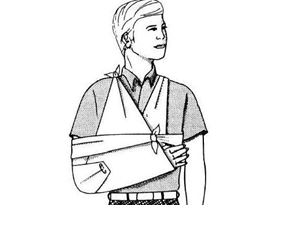
    4.For arm or shoulder injury, place splinted arm in sling, with hand above elbow level. Bind arm to victim's body by wrapping towel or cloth over sling and around upper arm and chest; tie towel or cloth under victim's opposite arm.

Create a sling for arm injuries using whatever
cloth you can find.

Warning signs:

  • A ‘snapping’ noise.
  • Pain.
  • Deformity.
  • Inability to move.
  • Swelling.
  • Bruising.

Helping:

  • Apply the RICE principle.
                  (i)  Rest the injured body part and the entire casualty.
                 (ii)  Immobilize the injured body part.
                 (iii) Cold compress over the injury to reduce swelling.
                 (iv) Elevate the injured body part if it can be done without causing further injury.
  • Seek medical help.
  • Do not rub or move the injured body part.
  • If there is a protruding bone then bleeding will need to be taken care of by applying indirect pressure.
  • Never straighten or realign an injured body part.

Notes:

  • Bone fractures, if set properly, will heal fully in a few weeks and will be stronger than before. This happens because the area builds up with more calcification than before.

Prevention:

  • Use safety equipment and wear it properly.
  • Use seat belts and car seats.
  • Keep joints and bones strong through weight bearing physical activities.

Splints:

The main purpose of a splint is to keep an injured body part immobilized (e.g. a broken leg). It should only be done if paramedics are going to take a long time arriving, or if you have to move the person. Never move or try to realign the injured body part. Always splint in the position found.

There are three main types of splints:

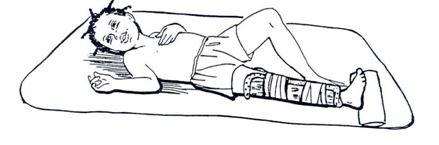
  1. Anatomical: this means using a non-injured body part to immobilize an injured body part. E.g. to splint a broken left lower leg you would tie both legs together so the good leg provides support to the injured leg.
  2.  Soft: this means using something like a thick sweat shirt, a jacket, a towel, or a blanket to wrap around and immobilize. This kind of splint works very well with hand or ankle/foot injuries.
  3. Rigid: this refers to using a firm object, such as a piece of wood, to immobilize. There are many types of rigid splints you can purchase or you can use whatever you see around you e.g. magazines, newspapers, umbrellas, etc.
  Splinting the lower leg using a rigid splint.

Splinting and slinging an injured forearm.

Splinting materials include splints, padding and bandages. Ensure that splints are long enough to immobilize the joint above and below the suspected fracture.
Before beginning first aid for fractures gather whatever splinting materials are available.
Splints may be improvised from such items as boards, poles, sticks, tree limbs, rolled magazines, rolled newspapers, or cardboard. If nothing is available for a splint, the person's chest can be used to immobilize a fractured arm and the uninjured leg can be used to immobilize, to some extent, the fractured leg.
Padding may be improvised from such items as a jacket, blanket, poncho or soft leafy vegetation. Put padding between the splint and the limb. Place extra padding at bony or sensitive areas.
Bandages may be improvised from belts or strips torn from clothing, towels or blankets. Narrow materials such as wire or cord should not be used to secure a splint in place.

Convey the Right Safety Information About Conveyors

www.safetygoodwe.com Convey the Right Safety Information About Conveyors Employees should be familiar with these basic ...