
Overview:
Snakes are remarkable animals, successful on land, in the sea, in forests, in grasslands, in lakes, and in deserts. Despite their sinister reputation, snakes are almost always more scared of you than you are of them. Most snakes do not act aggressive toward humans without provocation.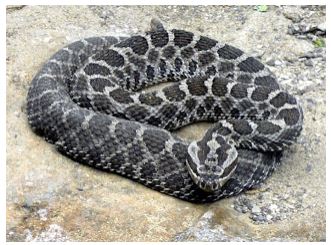
Snakes are meat eaters and they catch prey that includes insects, birds, small mammals, and other reptiles, sometimes including other snakes. Only about 400 of 3,000 snake species worldwide are poisonous. About 25 species of poisonous snakes are found in North America. Many snakes kill their prey by constriction. In constriction, a snake suffocates its prey by tightening its hold around the chest, preventing breathing or causing direct cardiac arrest. Snakes do not kill by crushing prey. Some snakes grab prey with their teeth and then swallow it whole.
Snakes are cold-blooded. Thus, they are unable to increase their body temperature and stay active when it is cold outside. They are most active at 25-32 C (77-90 F).
Definition:
Snake bites occur when a snake bites the skin. They are medical emergencies if the snake is venomous.Venomous animals account for a large number of deaths and injuries, worldwide. Snakes alone are estimated to inflict 2.5 million venomous bites each year, resulting in about 125,000 deaths. The actual number may be much larger. Southeast Asia, India, Brazil, and areas of Africa have the most deaths due to snakebite.
Alternative Names:
Bites - snakesConsiderations:
Snake bites can be deadly if not treated quickly. Children are at higher risk for death or serious complications due to snake bites because of their smaller body size.The right anti venom can save a person's life. Getting to an emergency room as quickly as possible is very important. If properly treated, many snake bites will not have serious effects.
Causes:
Venomous snake bites include bites by any of the following:- Cobra
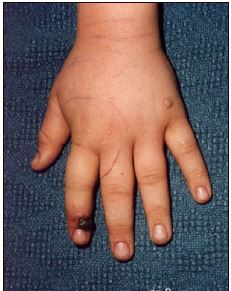
- Copperhead
- Coral snake
- Cottonmouth (water moccasin)
- Rattlesnake
- Viper
- Various snakes found at zoos
Snakes found in and near water are often mistaken as being venomous. Most species of snake are harmless and many bites are not life-threatening, but unless you are absolutely sure that you know the species, treat it seriously.
Symptoms:
- Bleeding from wound
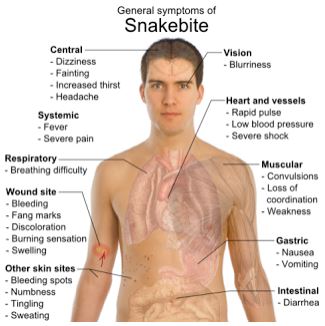
- Blurred vision
- Burning of the skin
- Convulsions
- Diarrhea
- Dizziness
- Excessive sweating
- Fainting
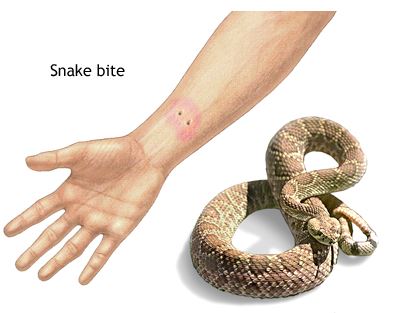
- Fang marks in the skin
- Fever
- Increased thirst
- Loss of muscle coordination
- Nausea and vomiting
- Numbness and tingling
- Rapid pulse
- Tissue death
- Severe pain
- Skin discoloration
- Swelling at the site of the bite
- Weakness.
- Bleeding
- Breathing difficulty
- Blurred vision
- Eyelid drooping
- Low blood pressure
- Nausea and vomiting
- Numbness
- Pain at site of bite
- Paralysis
- Rapid pulse
- Skin color changes
- Swelling
- Tingling
- Tissue damage
- Thirst
- Tiredness
- Weakness
- Weak pulse.
- Bleeding
- Breathing difficulty
- Low blood pressure
- Nausea and vomiting
- Numbness and tingling
- Pain at site of bite
- Shock
- Skin color changes
- Swelling
- Thirst
- Tiredness
- Tissue damage
- Weakness
- Weak pulse
Physically based symptoms:
- Most snake bites, whether by a venomous snake or not, will have some type of local effect. There can be minor pain and redness in over 90% of cases, although this varies depending on the site.
- Bites by vipers and some cobras may be extremely painful, with the local area sometimes becoming tender and severely swollen within 5 minutes. The bite area may also bleed and blister.
- Pit viper bites may include lethargy, weakness, nausea, and vomiting. Then over time may develop more life-threatening symptoms such as low blood pressure, rapid breathing, severe tachycardia (heart beats very fast), altered perception of what is happening around them and respiratory failure (breathing difficulty or breathing stops). It this happens CPR should be applied.
First Aid:
1. Keep the person calm. Reassure them that bites can be effectively treated in an emergency room. Restrict movement, and keep the affected area below heart level to reduce the flow of venom.2. If you have a pump suction device (such as that made by Sawyer), follow the manufacturer's directions.
3. Remove any rings or constricting items, because the affected area may swell. Create a loose splint to help restrict movement of the area.
4. If the area of the bite begins to swell and change color, the snake was probably venomous.
5. Monitor the person's
- vital signs
- pulse
- shock
- paleness
6. Get medical help right away.
7. Bring in the dead snake only if this can be done safely. Do not waste time hunting for the snake, and do not risk another bite if it is not easy to kill the snake. Be careful of the head when transporting it -- a snake can actually bite for several hours after it's dead (from a reflex).
Snake Identifiers:
Now lets get down to the points that serve as snake identifiers:- Length: When it comes to the length of the snake,
the first thing that you have to do is imagine how it would look when it
is stretched out. The small snakes would be up to 12 inches (30 cm)
long and they would include snakes like red belly snake, brown
snake. Then there are the medium sized snakes queen snakes, milk
snakes, etc. And then you have the large snakes like
the cobras, rattlesnakes, water snakes, etc.
- Shape: This acts as an important snake identifier. The question that you have to ask yourself is whether the body of the snake is slender, heavy or thick. The thick snake would include the cottonmouth, boa, etc. while the slender one will include the ribbon snake, vine snake, etc.
- Head: This might be a confusing snake identifier because many snakes are actually known to flatten their heads when they are threatened. This can be a bit confusing owing to the fact that pit vipers are known to have arrowheads.
- Eyes: This is rather a simply snake identification technique that can help you tell apart a poisonous from a non-poisonous one. Non-venomous snakes are known to have a round pupil whereas the venomous snakes are known to have a vertical pupil similar to the cat's eye.
When to Seek Medical Care:
Any snakebite victim should go to a hospital emergency department. Identification of the snake as venomous or nonvenomous should not be used as criteria whether to seek medical care. If someone can identify the type of snake, a call to the emergency department will help the staff prepare for quick treatment with antivenin, if needed. Bites by nonvenomous species require proper wound care. Victims should receive a tetanus booster if they have not had one within the last 5 years.Snake bite Self-Care at Home:
Common sense, hopefully, will guide a person's efforts if they are bitten by a snake or are witness to someone else being bitten. Even a bite from a nonvenomous snake requires excellent wound care. The patient needs a tetanus booster if he or she has not had one within 5 years. Wash the wound with large amounts of soap and water. Inspect the wound for broken teeth or dirt.Take the following measures:
- Prevent a second bite or a second victim. Do not try to catch the snake as this can lead to additional victims or bites. Snakes can continue to bite and inject venom with successive bites until they run out of venom.
- Identify or be able to describe the snake, but only if it can be done without significant risk for a second bite or a second victim.
- Safely and rapidly transport the victim to an emergency medical facility.
- Individuals should provide emergency medical care within the limits of their training.
- First, the victim should get to an emergency care facility as quickly as possible because antivenin (medicine to counteract the poisonous effects of the snake's venom) could be life-saving.
- Second, the affected limb should be used as little as possible to delay absorption and circulation of the venom.
Snakebite Prevention:
The snake is almost always more scared of the human, than the human is of the snake, it is assumed because giving the snake the opportunity to escape prevents most bites. However, most snakes will try to bite if cornered or frightened.- Avoid areas where snakes may be hiding, such as under rocks and logs.
- Even though most snakes are not venomous, avoid picking up or playing with any snake unless you have been properly trained.
- If you hike often, consider buying a snake bite kit (available from hiking supply stores). Do not use older snake bite kits, such as those containing razor blades and suction bulbs.
- Don't provoke a snake. That is when many serious snake bites occur.
- Tap ahead of you with a walking stick before entering an area where you can't see your feet. Snakes will try to avoid you if given enough warning.
- When hiking in an area known to have snakes, wear long pants and boots if possible.
- Snakebites are often associated with alcohol use. Alcohol intake can weaken a person's inhibitions, making it more likely that they might attempt to pick up a snake. Alcohol also decreases coordination, increasing the probability of a mishap.
- Individuals can help prevent significant bites by wearing boots while hiking or working where snakes may live. Long pants can reduce the severity of a bite. When in snake country, be cautious where you place your hands and feet (for example, when gathering firewood or collecting berries), and never walk barefooted.
Snakebite Dos and Don 'ts:
- DO remain calm and try to slow down your breathing by breathing in and out of your nose.
- DO keep the wound below your heart level.
- DO monitor your or the victims vital signs.
- DO keep the portion of the body that was bitten immobilized and move it as little as possible.
- DO wash the wound with soap and water if available.
- DO lay the victim flat with their feet raised about 1 foot above their body if they go into shock.
- DO remove any rings, necklaces, watches, ankle wraps, knee braces, or anything else that could be restrictive to proper blood flow.
- DO loosely apply a bandage roughly 2 to 4 inches above the bite on the side closest to your heart if you are unable to seek specialized care within approximately 30 minutes. However, the bandage should be loose enough to be able to place 1 to 2 fingers underneath it. The idea here is to slow down the venom without significantly disrupting blood flow or cutting off blood flow all together. Be sure to check the bandage frequently to ensure it remains semi-loose as the limb may continue to swell and require the bandage be readjusted.
Don 'ts:
- NO aspirin or other pain relievers.
- NO tourniquets. This cuts blood flow completely and may result in loss of the affected limb.
- DO NOT try to suck the venom out of the wound or cut into the bite with a knife. Such measures have not been proven useful and may cause further injury (see below explanation).
- DO NOT apply a cold compress or ice on the bite. Research has shown this to be potentially harmful.
- DO NOT raise the wound above the heart. Raising it can cause venom to travel into the body. Holding it down, can increase swelling.
- DO NOT use electric shock or a stun gun on the bite area. This method is under study and has yet to be proven effective. It could harm the victim.
- DO NOT wash the snake bite area treatment strongly recommend against cleaning the wound. Traces of venom left on the skin/bandages from the strike can be used in combination with a snake bite identification kit to identify the species of snake. This speeds determination of which anti-venom to administer in the emergency room.
- DO NOT try and capture the snake. If it's safe you can try to take a photo with a camera or with your phone. This is the best way in aiding snake identification.
Reassure the victims: Calm the victim down. Unnecessary panic will raise the pulse rate and blood pressure and moves the venom into the system faster. Tell the victim that 70% of snakebites are from non poisonous species. of the remaining 30% only half will actually involve injecting venom. The chances are they are OK !
Immobilise the bitten limb without compression: If the bite is on hand or arm place it in a sling bandage or use a piece of cloth to support the arm. In the case of leg bite, use a splint to support both legs and bandage them together . Do not tie the bandages tightly. we are only trying to immobilise not apply any pressure.
Get the patient to hospital as fast as safely possible: Don't waste time washing the wound, seeking traditional remedies or applying any drugs or chemicals to the victim. Science has shown that traditional remedies do not work and simply waste valuable time. Snakestones do not absorb venom and many herbal remedies make the situation worse. Keep the patient as immobile as possible


No comments:
Post a Comment