
Definition:
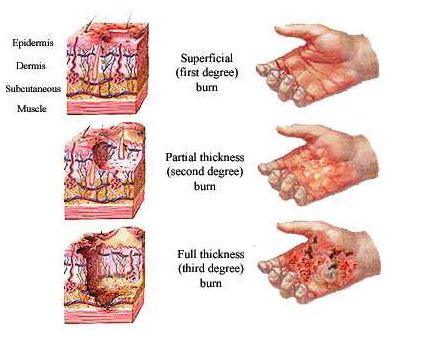
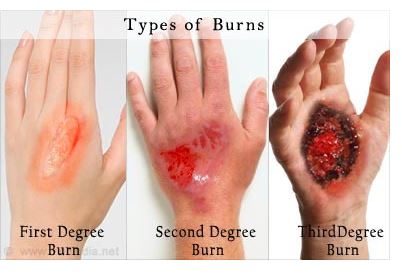
A burn is damage to the skin or underlying tissue caused by heat. There are 3 levels of severity; 1st (Superficial), 2nd (Partial thickness), 3rd (Full thickness).There are three levels of burns:
- First-degree burns affect only the outer layer of the skin. They cause pain, redness, and swelling.
- Second-degree burns affect both the outer and underlying layer of skin. They cause pain, redness, swelling, and blistering. They are also called partial thickness burns.
- Third-degree burns affect the deep layers of skin. They are also called full thickness burns. They cause white or blackened, burned skin. The skin may be numb.
Burns fall into two groups:
Minor burns are:- First degree burns anywhere on the body.
- Second degree burns less than 2-3 inches wide.
- Third-degree burns.
- Second-degree burns more than 2-3 inches wide.
- Second-degree burns on the hands, feet, face, groin, buttocks, or a major joint.
Causes:
Causes of burns from most to least common are:- Fire/flame.
- Scalding from steam or hot liquids.
- Touching hot objects.
- Electrical burns.
- Chemical burns.
Burns can be the result of: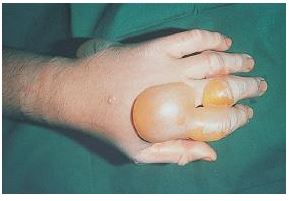
- House and industrial fires.
- Car accidents.
- Playing with matches.
- Faulty space heaters, furnaces, or industrial equipment.
- Unsafe use of firecrackers.
- Kitchen accidents, such as a child grabbing a hot iron or touching the stove.
You can also burn your airways if you breathe in smoke, steam, super heated air, or chemical fumes in poorly ventilated areas.
Symptoms:
Burn symptoms can include:
- Blisters (intact or ruptured and leaking fluid).
- Pain (How much pain you have is unrelated to the level of burn. The most serious burns can be painless.)
- Peeling skin.
- Shock (watch for pale and clammy skin, weakness, blue lips and fingernails, and a drop in alertness).
- Swelling.
- Red, white, or charred skin.
- Burns on the head, face, neck, eyebrows, or nose hairs.
- Burned lips and mouth.
- Coughing.
- Difficulty breathing.
- Dark, black-stained mucus.
- Voice changes.
- Wheezing.
Is it a minor burn or a major burn?
If it's not clear what level of care is needed, try to judge the extent of tissue damage, based on the following burn categories:1st-degree burn
A first-degree burn is the least serious type, involving only the outer layer of skin. It may cause:- Redness
- Swelling
- Pain
2nd-degree burn
A second-degree burn is more serious. It may cause:- Red, white or splotchy skin
- Swelling
- Pain
- Blisters
3rd-degree burns
The most serious burns involve all layers of the skin and underlying fat. Muscle and even bone may be affected. Burned areas may be charred black or white. The person may experience:- Difficulty breathing
- Carbon monoxide poisoning
- Other toxic effects, if smoke inhalation also occurred
Helping:
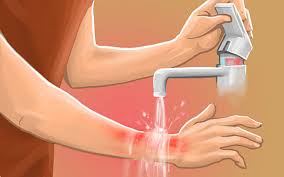
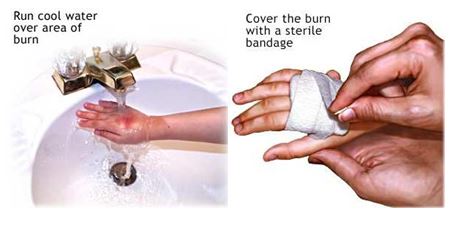
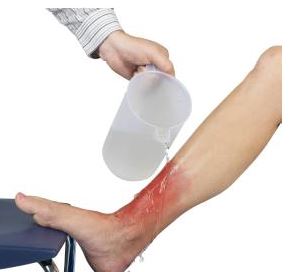
- For 1st and 2nd degree burns you should cool the area immediately with gently running cold water for about 10-15 minutes, or until it has cooled off. Do not break any blisters as this will make the wound worse.
- For 3rd degree burns do not put anything on the burn, seek medical help immediately and treat for shock. 3rd degree is extremely life threatening even when a small body part is affected. If there is clothing on the burn do not remove it as this may also remove skin. There is a very high risk of infection from this kind of burn.
Notes:
- As with all other emergencies make sure the area is safe for you first. Watch out for live wires, hot objects, chemical spills, etc.
- The severity of a burn can also be increased pending on;
- Which part of the body is affected, e.g. face, neck.
- The amount of the body that is burnt, e.g. only finger tip or entire arm.
- With electrical burns check for an exit wound as well as treating for the entrance wound.
- With chemical burns flush the area with lots of water to get it off the casualty’s skin.
- Never apply ointments, butter, or other home remedies on burns, as this may make the burn worse, keep the heat trapped in, or cause an infection.
First Aid:
Before giving first aid, it is important to determine what type of burn the person has. If you aren't sure, treat it as a major burn. Serious burns need immediate medical care.Call your local emergency number
For minor burns:
- Cool the burn to help soothe the pain. Hold the burned area under cool (not cold) running water for 10 to 15 minutes or until the pain eases. Or apply a clean towel dampened with cool tap water.
- Remove rings or other tight items from the burned area. Try to do this quickly and gently, before the area swells.
- Don't break small blisters (no bigger than your little fingernail). If blisters break, gently clean the area with mild soap and water, apply an antibiotic ointment, and cover it with a nonstick gauze bandage.
- Apply moisturizer, aloe vera lotion or gel, or low-dose hydro cortisone cream, which may provide relief in some cases.
- If needed, take an over-the-counter pain reliever, such as ibuprofen (Advil, Motrin IB, others), naproxen sodium (Aleve) or acetaminophen (Tylenol, others).
- Consider a tetanus shot. Make sure that your tetanus booster is up to date. Doctors recommend people get a tetanus shot at least every 10 years.
Major burns
Call emergency medical help for major burns. Until an emergency unit arrives, take these actions:- Protect the burned person from further harm. If you can do so safely, make sure the person you're helping is not in contact with smoldering materials or exposed to smoke or heat. But don't remove burned clothing stuck to the skin.
- Check for signs of circulation. Look for breathing, coughing or movement. Begin CPR if needed.
- Remove jewelry, belts and other restrictive items, especially from around burned areas and the neck. Burned areas swell rapidly.
- Don't immerse large severe burns in cold water. Doing so could cause a serious loss of body heat (hypothermia) or a drop in blood pressure and decreased blood flow (shock).
- Elevate the burned area. Raise the wound above heart level, if possible.
- Cover the area of the burn. Use a cool, moist, bandage or a clean cloth.
Considerations:
Severe burns need immediate medical care. This can help prevent scarring, disability, and deformity.Burns on the face, hands, feet, and genitals can be particularly serious.
Children under age 4 and adults over age 60 have a higher chance of complications and death from severe burns because their skin tends to be thinner than in other age groups.
When to Contact a Medical Professional:
Call your local emergency number if:- The burn is very large - about the size of your palm or larger.
- The burn is severe (third degree).
- You aren't sure how serious it is.
- The burn is caused by chemicals or electricity.
- The person shows signs of shock.
- The person breathed in smoke.
- Physical abuse is the known or suspected cause of the burn.
- There are other symptoms associated with the burn.
Call immediately if signs of infection develop. These signs include:
- Drainage or pus from the burned skin.
- Fever.
- Increased pain.
- Red streaks spreading from the burn.
- Swollen lymph nodes.
Also call immediately if symptoms of dehydration occur with a burn:
- Decreased urination
- Dizziness
- Dry skin
- Headache
- Light- headedness
- Nausea (with or without vomiting)
- Thirst
Prevention:
To help prevent burns:- Install smoke alarms in your home. Check and change batteries regularly.
- Teach children about fire safety and the hazards of matches and fireworks.
- Keep children from climbing on top of a stove or grabbing hot items like irons and oven doors.
- Turn pot handles toward the back of the stove so that children cannot grab them and they cannot accidentally be knocked over.
- Place fire extinguishers in key locations at home, work, and school.
- Remove electrical cords from floors and keep them out of reach.
- Know about and practice fire escape routes at home, work, and school.
- Set the water heater temperature at 120 degrees or less.
Dos:
- Stop the burning. Remove the victim from the heat source.
- Check for any airway obstruction, and to check breathing and circulation. Administer CPR if necessary.
- For thermal, chemical or contact burns, the first step is to run
cold water over the burn for a minimum of 30 minutes. If the burn is
small enough, keep it completely under water. Flushing the burn takes
priority over calling for help. Flush the burn FIRST.
- Remove clothing that is not stuck to the burn by cutting or tearing it.
- Remove rings, belts, shoes and tight clothing before swelling occurs.
- Cover the burn with a clean, cotton material. If you do not have clean, cotton material, do not cover the burn with anything.
- Keep the victim covered with a blanket to maintain a normal body temperature until medical help arrives.
- Call immediately for emergency medical assistance if the burn is extensive/ severe/ chemical/ electrical burn/ uncertainty about the burn's severity/ the victim shows signs of shock/ the victim has an airway burn.
Do Not:
- Do NOT apply ointment, butter, ice, medications, cream, oil spray, or any household remedy to a severe burn.
- Do NOT breathe, blow, or cough on the burn.
- Do NOT disturb blistered or dead skin.
- Do NOT remove clothing that is stuck to the skin.
- Do NOT give the person anything by mouth, if there is a severe burn.
- Do NOT place a severe burn in cold water. This can cause shock.
- Do NOT place a pillow under the person's head if there is an airways burn. This can close the airways.
FIRST AID FOR BURNS
 |
Safety Videos |
Sometimes, inspite of taking precautions, fires do occur and people get burnt. Here’s what you should do in an emergency to minimize the effect of burn:
- In the event of a burn injury, the affected portion of the body should be placed under cool, slowly running water, or be immersed in cool water for about 10 minutes or till pain subsides.
- Remove jewellery before the burnt area begins to swell and do not break blisters.
- Cover burnt area with a clean, sterile dressing.
- Remove clothing from affected area if burn is superficial. (Superficial burns involve only outer layers of skin).
- Do not remove clothing if it is a deep tissue burn. (Deep tissue burns involve the entire thickness of the skin).
- Lay the victim down.
- Badly burnt limb should be immobilized (hold in such a way that it cannot be moved).
- Give small amounts of cool water If victim is conscious. (If unconscious, DO NOT give any liquid).
- Reassure the victim and keep him calm.
- Immediately take the victim to the hospital, which has a burn-ward.
- Never apply ghee, butter, oil or any greasy substance on the burnt area.
REMEMBER TO POUR WATER OVER BURNS
Visit for Safety Videos: https://www.youtube.com/channel/UChREXvbLQ3fPxOLKflPRj_g


No comments:
Post a Comment