
Cardiopulmonary Resuscitation (CPR) Definition
Cardiopulmonary resuscitation (CPR) is a procedure performed in an emergency when the heart stops, with the goal of prolonging circulatory and lung function.
The Importance of CPR:
Although advances in emergency cardiac care continue to improve the
chances of surviving cardiac arrest, cardiac arrest remains a leading
cause of death in many parts of the world.Each year a many peope die from heart disease. Half of these will die suddenly, outside of the hospital, because their heart stops beating.
- The most common cause of death from a heart attack in adults is a
disturbance in the electrical rhythm of the heart called ventricular
fibrillation.
- Ventricular fibrillation can be treated, but it requires applying an electrical shock to the chest called defibrillation.
- If a defibrillator is not readily available, brain death will occur in less than 10 minutes.
- One way of buying time until a defibrillator (AED) becomes available
is to provide artificial breathing and circulation by performing
cardiopulmonary resuscitation, or CPR.
- The earlier you give CPR to a person in cardiopulmonary arrest (no breathing, no heartbeat), the greater the chance of a successful resuscitation.
- By performing CPR, the affected individual receives oxygenated blood flowing to the heart and brain until a defibrillator becomes available.
- The first link in the chain of survival is immediate recognition of cardiac arrest and activation of the emergency response system by calling at emergency no. of country (check your community plan, some communities require dialing a different number).
- The next link in the chain of survival is to perform CPR until a defibrillator becomes available.
- The next link in the chain of survival is to perform early CPR, with an emphasis on chest compressions until a defibrillator becomes available.
- Following early CPR, the next link is to provide rapid defibrillation.
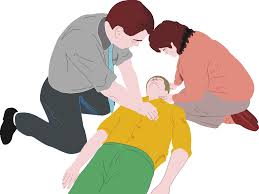
- In many areas of the country, simple, computerized defibrillators, known as automated external defibrillators, or AEDs,
- may be available for use by the lay public or first person on the scene.
- Once the EMS unit arrives, the next link in the chain of survival is effective advanced life support care. This involves administering medications, using special breathing devices, and providing additional defibrillation shocks if needed.
Cardiac Arrest:
When a person develops cardiac arrest, the heart stops beating. There is no blood flow and no pulse. With no blood flowing to the brain, the person becomes unresponsive and stops breathing normally.- When you discover a person whom you believe is experiencing a medical emergency, the first thing to do is check for responsiveness. Gently shake the victim and shout, "Are you OK?"
- If the person does not respond to your voice or touch, they are unresponsive. If the victim is unresponsive and you are alone, leave the victim and immediately call emergency. If someone is with you, tell him or her to call emergency and then return to help you.
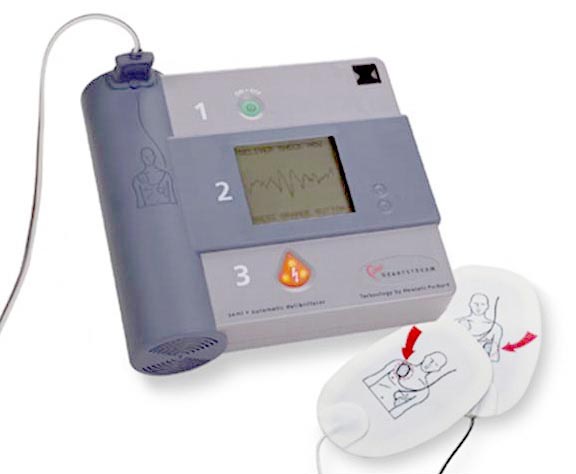
- If an AED is available, bring it back to the person's side. The moment an AED becomes available, IMMEDIATELY press the "on" button. The AED will begin to speak to you. Follow the directions to use the AED.
Start with Chest Compression
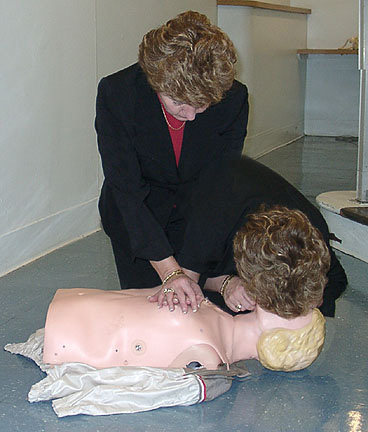
- If the person is not breathing normally, begin doing chest
compression. Place the heel of one hand on the center of the chest,
right between the nipples. Place the heel of your other hand on top of
the first hand. Lock your elbows and position your shoulders directly
above your hands. Press down on the chest with enough force to move the
breastbone down about 2 inches. Compress the chest 30 times, at a rate
of at least 100 times per minute (slightly faster than once every
second). Allow the chest to completely recoil after each compression.
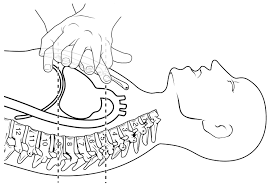
- After 30 compression, stop, open the airway while keeping the victim's head tilted back, and provide two slow breaths. Place your mouth around the victim's mouth and pinch the nose shut. Then, position your hands in the same spot as before and perform another 30 chest compression. Continue the cycles of 30 compression's and two breaths until an AED becomes available or until EMS providers arrive. With the fear of contracting an infection from a person by providing mouth to mouth breathing, it is no longer necessary to provide two breaths to the affected individual. The most important step you can provide is at least 100 compression's per minute to the affected individual until help arrives.
- This technique of performing CPR may be used on anyone older than eight years of age.
CPR in Children
Sudden cardiac arrest is less common in children than it is in adults. It usually occurs when there is a lack of oxygen caused by a breathing problem such as choking, near-drowning, or respiratory infections.In order to use an AED on a child from one year of age through eight years of age a special pediatric cable is used to reduce the amount of energy provided by the electrical shock.
Doing CPR on children aged one year to eight years is similar to doing CPR on adults. However, there are some minor differences. Most are due to the child's smaller size.
- When compressing the chest, the heel of only 1 hand is used instead of two hands, and the chest is pressed down approximately 2 inches.
- Perform 5 cycles of 30 chest compression's followed by two breaths, then use an AED to evaluate the heart rhythm if available. If an AED is not available, and the child is still not breathing normally, coughing, or moving, continue cycles of 30 compression's to two breaths until help arrives.
CPR in Infants:
An infant is defined as a child younger than one year of age. Because an infant is smaller than a child, the CPR technique for infants contains further changes.- Even smaller breaths are given-enough to just get the chest to rise. Only two fingers are used to compress the chest down about 1 and 1/2 inches.
- Otherwise, the CPR sequence is the same as for the child.
- Manual defibrillation is the preferred method of defibrillation in infants, however, if only an AED is available, it is recommended that a pediatric AED cable be used for infant defibrillation.
CPR Pictures:
- Check for responsiveness by gently shaking the victim and shouting, "Are you OK?".
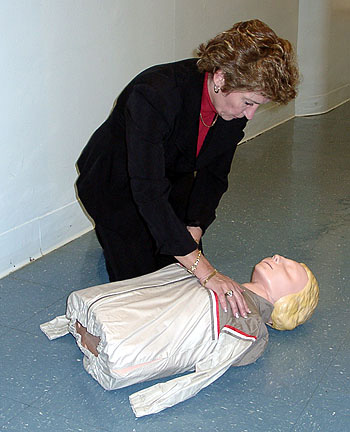
- If the victim is unresponsive, immediately call EMERGENCY. If an automated external defibrillator is available, bring it to the person's side.
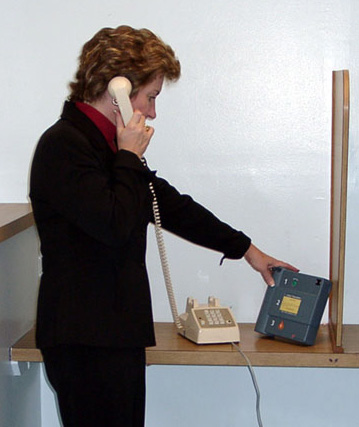
- The moment an AED becomes available, IMMEDIATELY press the "On" button. The AED will speak to you. Follow the directions given.
- Place the heel of one hand on the center of the chest, right between the nipples. Place the heel of your other hand on top of the first hand. Lock your elbows and position your shoulders directly above your hands.
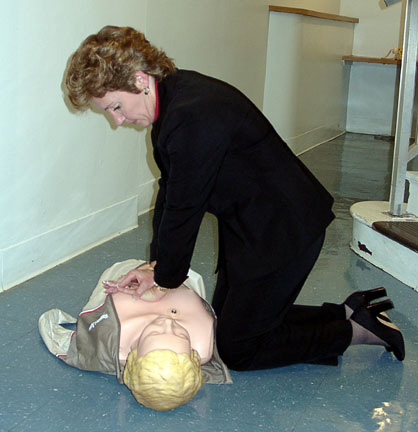
- Press down on the chest with enough force to move the breastbone down about 2 inches. Compress the chest 30 times, at a rate of at least 100 times per minute
- Provide two rescue breaths. Place you mouth around the victim's mouth; pinch off the nose and administer two slow breaths. Make sure the chest rises with each breath.
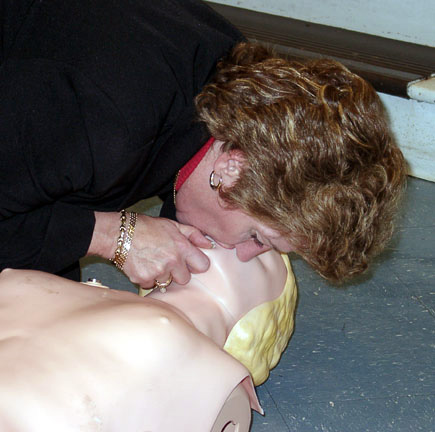
- Repeat the 30 compressions and two breaths until help arrives.

- Is the person conscious or unconscious?
- If the person appears unconscious, tap or shake his/her shoulder and ask loudly "Are you Ok" ?
- If the person doesn't respond call the emergency help line number and begin doing CPR.

Remember the ABCs:
Think ABC - Air way, Breathing, Circulation.

- Air way - Open the airway with the tilt -chin method.
- Breathe - give two breaths.
- Check circulation.
If there is in no pulse or breathing, perform chest compressions - 15 compressions and breaths.
- Keep the head slightly backward and 12 breaths.
- Seal the casualty's nose to prevent escape of air by pinching with thumb and index finger.
- Take a deep breathe, open your month widely, place it with the victim's mouth and make a tight seal.
- Quickly below the full breath into the mouth of the victim.
- Remove your mouth from the victim and allow him to exhale passively.
- Repeat the procedure till the medical aid arrives.


No comments:
Post a Comment