
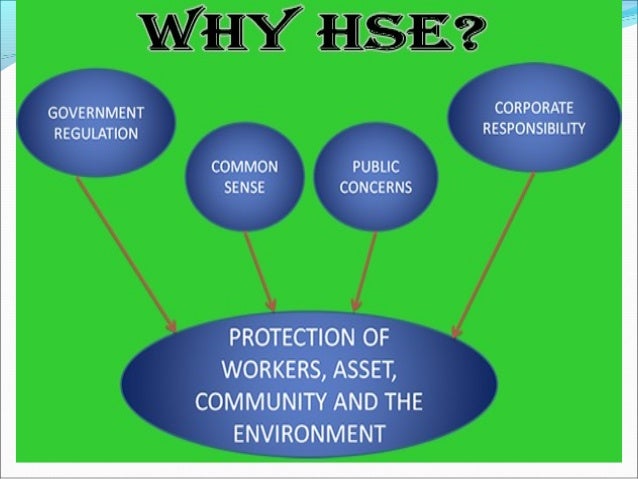
Health Safety and Environment (HSE) departments, also called SHE or EHS departments, are entities commonly found within companies that consider safety at work, occupational health and environmental protection as important as providing quality products, and which therefore have managers and departments responsible for these issues. HSE management has two general objectives: prevention of incidents or accidents that might result from abnormal operating conditions on the one hand and reduction of adverse effects that result from normal operating conditions on the other hand.
Safety can be limited in relation to some guarantee or a standard of insurance to the quality and un harmful function of an object or organization. It is used in order to ensure that the object or organization will do only what it is meant to do.
It is important to realize that safety is relative. Eliminating all risk, if even possible, would be extremely difficult and very expensive. A safe situation is one where risks of injury or property damage are low and manageable.
History of the HSE profession
These initiatives involve tasks such as:
- Developing and leading a formal sustainability program
- Creating successful internal partnerships to integrate HSE values and practices across the business
- Communicating enterprise risks associated with safety , health, or environmental failures
- Establishing global corporate HSE standards and practices
- Publicly reporting progress on a full spectrum of HSE and sustainability initiatives
- Responding to stakeholder inquires about their company’s HSE and sustainability performance
- Working with supply chain
- Global auditing
- Ensuring safe and healthy workplaces
HSE Professional roles and responsibilities:
HSE professional jobs are composed of, there are many rules and regulations that should be kept in mind.
- The development and implementation of all the health and safety programs in the company. They are very much responsible for all employees’ safety at work and the use of proper safeguards.
- Check the company’s compliance with all environmental standards and regulations.
- Account the assessment of the company’s overall workflow. These specialists, along with other members of the senior management team also implements the policies that is needed for the use of personal protective equipment.
- Responsible for all the details in the procedures that is potentially dangerous in order for the employees to have better knowledge of how to lower their risk of injuries and other dangerous threats.
- Responsibility to conduct on-going training regarding safety for all employees in the company.
- Make sure that new employees receive their timely orientations and introduction regarding their training in their specific area in the company.
- Expected to be professional and well-versed when it comes to the requirements of the rules and regulations that help protect the worker’s health and safety. He or she must be able to identify and call out which regulations should apply to a certain industry or company.
- Conduct routine safety meetings in order for them to review the new procedures and policies needed for all employees. These essential safety meetings help give staff members the chance to share their safety issues, observations and also other suggestions for environmental health and safety improvements in the future.
Key Role and Responsibilities As Per Designation:-
- Develops and implements comprehensive safety policies and procedures.
- Ensures compliance with local, state, and federal safety regulations.
- Oversees safety audits, risk assessments, and incident investigations.
- Provides leadership and guidance to the safety team.
- Collaborates with other departments to foster a culture of safety.
- Monitors daily operations to ensure adherence to safety protocols.
- Conducts regular safety inspections and identifies potential hazards.
- Provides training and guidance to employees on safety practices.
- Investigates accidents and implements corrective measures.
- Enforces the use of personal protective equipment (PPE).
- Manages safety programs across multiple sites or projects.
- Coordinates with contractors and stakeholders to maintain safety standards.
- Reviews and updates safety plans based on project requirements.
- Oversees the implementation of emergency response plans.
- Ensures that safety goals are met within budget and timelines.
- Conducts detailed inspections of equipment, facilities, and work practices.
- Identifies non-compliance issues and recommends corrective actions.
- Prepares reports on inspection findings and follows up on resolutions.
- Ensures that safety signage and warnings are properly displayed.
- Stays updated on safety regulations and industry standards.
- Acts as a liaison between employees and management on safety matters.
- Promotes awareness of safety policies and procedures among staff.
- Participates in safety committee meetings and provides feedback.
- Reports unsafe conditions or practices to the appropriate authorities.
- Encourages a proactive approach to workplace safety.
Here's a list of duties that a might typically undertake:
- Develop and implement safety policies and procedures.
- Conduct safety inspections and audits regularly.
- Ensure compliance with safety regulations and standards.
- Provide safety training to employees.
- Investigate accidents and incidents, and prepare reports.
- Analyze data to identify potential hazards.
- Recommend and implement corrective actions.
- Maintain safety records and documentation.
- Conduct risk assessments in the workplace.
- Promote a safety culture among employees.
- Monitor safety equipment and ensure proper functioning.
- Coordinate emergency response drills and procedures.
- Conduct safety meetings and briefings.
- Evaluate workplace hazards and develop mitigation strategies.
- Collaborate with management to prioritize safety initiatives.
- Respond to employee safety concerns and inquiries.
- Develop and update safety manuals and guidelines.
- Review and approve safety-related permits and plans.
- Implement ergonomic assessments and improvements.
- Coordinate with external safety agencies and authorities.
- Conduct safety-related investigations and root cause analysis.
- Lead safety committees or teams.
- Create and deliver safety awareness programs.
- Assess and recommend personal protective equipment (PPE).
- Monitor and enforce safety regulations on job sites.
- Conduct safety-related training for contractors and visitors.
- Ensure proper labeling of hazardous materials.
- Investigate near misses and potential risks proactively.
- Participate in safety-related meetings and conferences.
- Analyze incident trends and suggest preventive measures.
- Develop emergency response plans.
- Monitor and control chemical handling and storage.
- Implement safety communication strategies.
- Conduct safety audits of machinery and equipment.
- Review and approve safety procedures for new projects.
- Collaborate with HR for safety-related policies.
- Conduct safety-related research for best practices.
- Ensure safety compliance during construction projects
- Develop evacuation plans and conduct drills.
- Coordinate with medical facilities for emergency preparedness.
- Provide guidance on occupational health hazards.
- Assess and manage workplace noise levels.
- Review and update evacuation routes and signage.
- Implement safety incentives or recognition programs.
- Conduct safety-related performance evaluations.
- Analyze incident and injury reports for trends.
- Conduct safety-related surveys or questionnaires.
- mplement safety software for tracking and reporting.
- Keep abreast of changing safety regulations.
- Provide regular safety updates to management and staff.


No comments:
Post a Comment