
Definition:
A sprain is an injury to the ligaments around a joint. Ligaments are strong, flexible fibers that hold bones together. When a ligament is stretched too far or tears, the joint will become painful and swell.
A Dislocation is when the
bone becomes separated from the joint it meets, or it pops out of it’s
socket. This sometimes happens when the bone and joint are over
stressed. They an also be caused by contact sports, rheumatoid
arthritis, inborn joint defects, and suddenly jerking that arm or hand
of a small child. Dislocation is most common in the shoulders, but
fingers, hips, ankles, elbows, jaws, and even the spine are also prone
to dislocation.
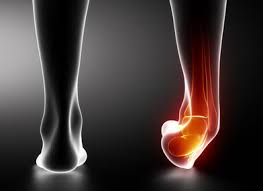 Causes of Sprains :
A sprain is usually caused by trauma to a joint (the space between
bones). Twisting or forces overstretch the ligaments (such as hyperex
tension or hyper flexion) and can cause tears in the ligament tissue,
which can be graded from mild to severe depending on the amount of
damage. Sprains can happen when people twist an ankle or knee or fall on
an elbow or shoulder. A strain is usually the result of overstretching
or overuse of muscles and tendons. An acute strain can be the result of
sudden twisting or trauma to the muscles or tendons. Chronic strains are
the consequence of overuse of muscles and tendons, such as with
athletes who train constantly and do not rest adequately.Both of these injuries are commonly confused with fractures (broken bones) because they all exhibit many of the same symptoms.
symptoms are:
- Pain
- Swelling
- And an inability to move and bear weight
- A misshapen appearance
- Any discoloration
Ankle sprain - series:
Normal anatomy:
The ankle joint connects the foot with the leg. The ankle joint allows the foot to move upward and downward and in an inward and outward motion. Muscles, tendons, and ligaments surround the ankle providing the stability the ankle joint needs for walking and running.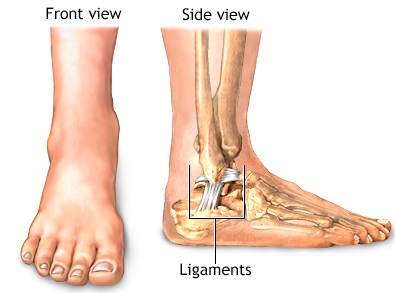
Type I ankle sprain:
The most common way the ankle can be injured is by an ankle sprain. When an ankle is sprained ligaments on the ankle are either stretched, partially torn or completely torn. The most common type of sprain is an inversion injury, where the foot is rotated inward. Ankle sprains can range from mild, to moderate, and severe. Type 1 ankle sprain is a mild sprain. It occurs when the ligaments have been stretched or torn minimally.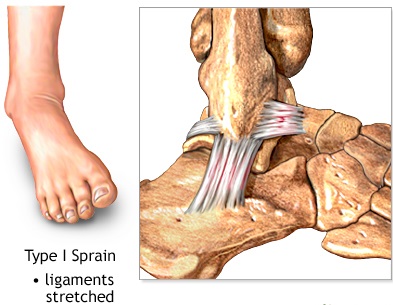
Type II ankle sprain:
Type II ankle sprain is a moderate level of sprain. It occurs when some of the fibers of the ligaments are torn completely.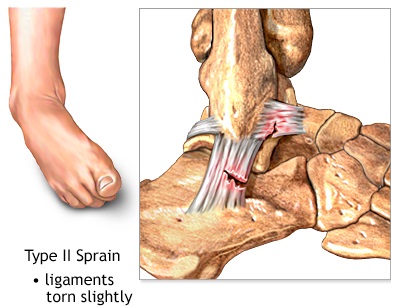
Type III ankle sprain:
Type III ankle sprain is the most severe ankle sprain. It occurs when the entire ligament is torn and there is great instability of the ankle joint.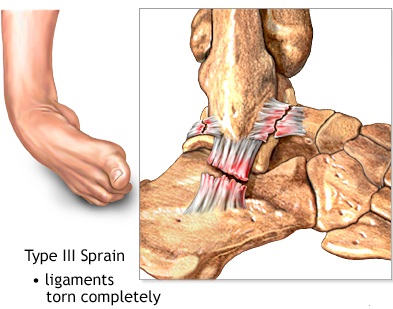
Early treatment of injury:
Minor injuries like sprains may be treated at home if broken bones are not suspected. The acronym RICE is helpful in remembering how to treat minor injuries: "R" stands for rest, "I" is for ice, "C" is for compression, and "E" is for elevation. Pain and swelling should decrease within 48 hours, and gentle movement may be beneficial, but pressure should not be put on a sprained joint until pain is completely gone (one to several weeks).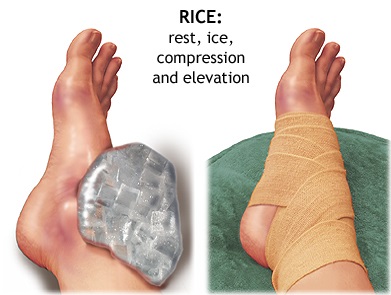
First Aid:
-
Apply ice right away to reduce swelling. Wrap the ice in cloth. Do not place ice directly on the skin.
-
Wrap a bandage around the affected area to limit movement. Wrap firmly, but not tightly. Use a splint if needed.
-
Keep the swollen joint raised above your heart, even while sleeping.
-
Rest the affected joint for several days.
Keep pressure off the injured area until the pain goes away. Most of the time, a mild sprain will heal in 7-10 days. It may take several weeks for pain to go away after a bad sprain. Your health care provider may recommend crutches. Physical therapy can help you regain motion and strength of the injured area.
Use the PRICE technique:
Protect- if possible make a
splint to help immobilize the affected area. Rulers and cloth, rolled up
magazines and a belt, branches and shoelaces; all types of things can
be used to make a splint. This will help prevent further damage to the
limb. Do not try to re-position the bone/joint while making the splint.Rest- Avoid movement of the injured area and avoid participation in activities where you may be at risk to re-injure yourself until after the wound had had plenty of time to heal.
Ice- Use ice to minimize swelling. If no ice is available, a bag of frozen veggies is a good substitute.
Compression- An elastic or fabric bandage may help decrease swelling and ease the pain. Ask a doctor before using one and make sure the bandage is not wrapped to tightly, which would hinder circulation.
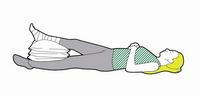
Elevation- If possible raise the injured limb up above the heart. Support the elevated limb in a sling or under a pillow or folded blanket.
How to bandage a sprain:
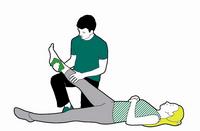
If someone’s sprained a joint, like an ankle, knee or elbow, you can use a bandage to support the limb.To make sure you give the right kind of support, bend the joint slightly and then wrap the bandage in a figure-of-eight. You need to wrap it either side of the injury too, to give enough support for the whole area.
(For this example we’re going to describe how to wrap an ankle, but you can use the same method to bandage an elbow or knee).
What you need to do
- To bandage someone’s ankle, use a roller bandage
- First, you need to hold the ankle in a comfortable position, with the joint slightly bent
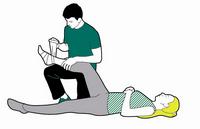
- Start by putting the end (tail) of the bandage on the inside of
their ankle. Pass the bandage over and around to the outside of the
ankle, and go round one and-a-half times, so that the tail end of the
bandage is firmly covered and won’t come loose.
- Then make a figure-of-eight around the joint, wrapping the bandage diagonally above and then below the joint
- Keep going with the figure-of-eight, but each time, only cover about two thirds of the previous layer, so that with each new layer you’re covering a third of new skin
- Once you’ve done this several times, wrap the bandage straight around the ankle a couple of times, and then fasten the end using a safety pin, sticky tape or by tucking it in
- As soon as you’ve finished, check their toes for circulation, by pressing their big toe nail for five seconds until it goes pale. If the color doesn’t come back within two seconds after you stop pressing, the bandage is too tight so you’ll need to loosen it and do it again. Their ankle could keep swelling after you’ve bandaged it, so keep checking their circulation every ten minutes.
When to Contact a Medical Professional:
Go to the hospital right away or call emergency if:- You think you have a broken bone.
- The joint appears out of position.
- You have a serious injury or severe pain.
- You hear a popping sound and have immediate problems using the joint.
-
Swelling does not start to go away within 2 days.
-
You have symptoms of infection, including red, warm, painful skin or a fever over 100°F.
-
The pain does not go away after several weeks.
Treatments and warnings:
Because of this, the same first aid care can be used for all three of these injuries.- If you suspect a dislocation do not try to put the bone back into its socket, you may only make the injury worse.
- If you suspect a dislocation in the neck or spine be very careful
and do not try to move the person yourself unless absolutely necessary,
as damage may have been done to the spinal cord (which may paralyze
parts of the body below the injury site.) Also, if you suspect an injury
this serious call emergency immediately.
- If the site of injury is bleeding then treat the wounds and cuts accordingly, but do not try to reset/reshape the bone or joint. Also look for signs of shock.
- If the pulse is weak below the affected area call emergency and loosen all restrictive clothing.
-
If the person is in severe pain, or the injury is to the neck, spine, hips, or thigh bone, call emergency.
- If the joint or bone needs to be re-positioned, do not give the person anything to eat or drink as it will put off medical treatment.
- Remove any articles of clothing or jewelry covering the affected area, or restricting blood flow to it.
- You may give over the counter pain medications such as acetaminophen and ibuprofen as directed by the doctor. If there is bleeding do not give aspirin because aspirin is a mild blood thinner and will delay clotting.
Prevention of Sprains :
It is possible to prevent many sprains and strains from occurring. The American Academy of Orthopedic Surgeons suggests the following to help reduce one's injury risk:- Participate in a conditioning program to build muscle strength.
- Do stretching exercises daily.
- Always wear properly fitting shoes.
- Nourish the muscles by eating a well-balanced diet.
- Warm up before any sports activity, including practice.
- Use or wear protective equipment appropriate for that sport.
- maintaining a healthy weight;
- wearing proper-fitting shoes, designed for the specific activity;
- keeping household areas safe to prevent falls;
- not participating in sports or exercise if overly tired or in pain.


No comments:
Post a Comment